The Viewer on my Mind

Dear Bubbles:
You have talked about how the viewer is going to perceive your composition, but how much do you consider the viewer when you’re composing?
~Areef
Dear Areef:
The answer is the standard answer to nearly every photography question: it depends. I do, but I don’t.
It depends largely on how you define photography as an art form: is it a shared art, a relational exchange between a photographer and viewer? Or is it an individual expression, an act of experiencing that holds value without sharing? Both are right answers.
If we view photography as a shared art, as a dance between a photographer and a viewer, as an expression paired with interpretation, then our responsibility is not merely to record what we experience, but to compose with intention. We need to determine what we want to say—and how—to our audience: our vision, our message, our intent, our purpose, or the meaning of the moment we’ve chosen to elevate into a frame.
I believe every composition offers a visual pathway. It’s our responsibility as photographers to present the viewer not just an object they look at, but rather an experience in which they engage. We become guides.
To accomplish this, I use visual language based in Gestalt psychology and human perceptions. I consider how humans perceive the visual world, make order out of chaos, and organize that order into patterns so that I can more effectively communicate in visual form what I care to share about what I’m experiencing.
As I’m composing, I give thought to where the viewer’s eye will start in the frame. What will grab their attention? And why? Is that aligned with my intent? Based on human perception studies, we know that certain things tend to grab humans’ attention. Things like bright tones, major color contrasts, bold colors (especially red, yellows, and oranges), texture/detail (areas of the frame that are in focus vs. blurred), distinct lines or shapes, or obvious breaks in patterns tend to stand out.
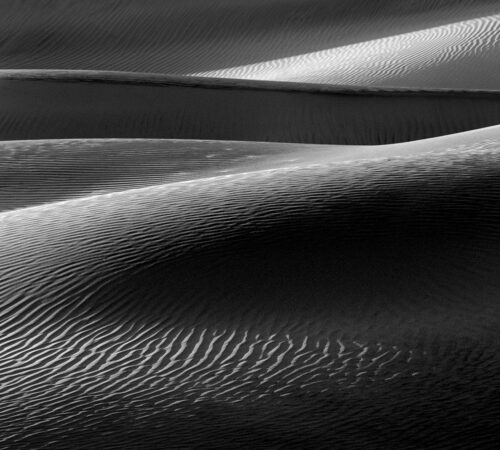
Once we have successfully lured a viewer in, where do we take them within in the frame? Where does the viewer’s eye go next? And why? The simple orientation of a frame can influence eye movement. Vertically oriented frames cause more energetic up and down eye movement. Horizontally oriented frames trigger wide side to side eye movement. Square frames tend to provoke circular movement within a symmetrical balance.
Other visual cues that can help direct a viewer’s eye around the frame include other bright tones, more subtle colors (like blues, greens, and purples), connecting lines, proximity between shapes (which can lead to fast or slow motion depending on the distance), repeating patterns, blurry or out of focus areas, or negative space (where the eye can rest).
I also consider what’s likely to cause the viewer to stop engaging with my photograph. What’s distracting and not supporting my message? Things like static positioning of visual elements, competition between elements, clutter or busyness, light leaks on the frame’s edges, blurriness without structure, lines leading out of the frame, odd crops, lack of visual anchors, or off-kilter balance can contribute to viewer disengagement.
Finally, I consider the payoff for the viewer. Why is my photograph worth staying with for the viewer? What do they get out of it? What thoughts or emotions might it trigger? Humans connect with story, gesture, mood, metaphor, symbolism, tension, harmony, juxtaposition, surprise, and even ambiguity and space for reflection.
The viewer need not interpret the image exactly as I do. In fact, they likely won’t. We may offer our own story through our photograph, but a viewer may bring their own memory, bias, culture, and emotions. And sometimes that can lead to completely opposite interpretations than we intended. Some may see resilience when you felt grief. They may feel grief when you felt awe. In the photograph at the top of the post, does the red leaf at the top of the frame represent disconnection or freedom—or something entirely different? Could you describe the story I was trying to create word for word? Of course not. How I felt in the moment is irrelevant to how you interpret my visual expression.
The point of photography isn’t to create an echo of the same sentence between the two parties. It’s to build connections and dialogue. Photographers do not (and cannot) control the viewer’s interpretation, but we can control our clearest communication of our intentions as possible. Meaning can expand and transform through sharing.
But composing with the viewer in mind does not mean looking for approval. When I’m connecting with the landscape in the moment, I do not think about whether my viewer thinks I should position my rock here or there. I do not care if they like the color red more than blue. I do not consider whether a viewer will like my image on Facebook or care enough about it to buy a print. To do so would mean defaulting to predictable and popular compositions instead of elevating my own authenticity and truth—the latter being immensely more important to me than the former.
If I share my image (and that’s a big if: I only share about 3% of my frames…), I offer it to expand perspectives, share what’s meaningful to me, and inspire others to continue their journey of discovery and connection. It’s MY meaning. It’s MY moment. It’s MY expression. Don’t like it? That’s cool. Move on with your life, I’ll move on with mine.
I often joke, paraphrasing a quote by Eleanor Roosevelt: “What other people think of your photographs is none of your business.”
Here’s the funny thing, though: I consider the viewer’s journey—how someone will experience my frame—regardless of whether a viewer ever sees my photograph. Why bother considering a viewer I may never have?
Because, in addition to being a shared art, photography also enables individual expression. Because composing with intention builds my own visual literacy and sharpens my own perspectives. It deepens my awareness of not just my photograph or message, but of myself and the world around me.
Composing with human perception in mind forces me to ask, what is this photography truly about? Where does my eye go first? Where does it go next? What’s distracting? What’s the reason I’m making this photograph. These questions strengthen my ability to make order out of chaos and lead to clarity of my vision. This practice continually teaches me how to experience and express my surroundings.
I also consider an outsider’s reaction because I care to perfect my expression and how I communicate because I just do. (And by that I mean, I’m a recovering perfectionist incapable of not not caring.) I don’t care if anyone ever sees the results of this effort. I know that my photograph has still produced value, if only to me, even if no one ever sees it. The heart of my practice comes from a love of discovery and creation first—if others find value in my photographs later, excellent. If not, excellent.
A photograph does not require witnesses to hold value. A photograph can be an act of experiencing, not showing. So many of my photographs were made as personal explorations, reckonings, maybe even therapy. Few, if any outsider, would understand some of my frames. That’s OK. They were still worth making. Not all art is meant for consumption.
What is the purpose of your art? Why do you make photographs? Do you create your photography for yourself or for others? You can do both, and we can all have different answers and they be right ones for ourselves.
What’s the role of the viewer in your process? As you consider how the viewer plays into your photography, I’d caution you from clinging too tightly to defining photography as purely a shared art or as purely self-expression. If we insist it is solely shared art, we risk diluting authenticity in pursuit of approval. If we insist photography is solely self-expression, we risk neglecting clarity and visual empathy. It can be both. We can compose with intention because we value both our own insights and those of others. Our medium may be perceptual, but it relies upon shared human perceptions.
So yes, I consider how people might engage with my photograph. No, I don’t compose for applause or validation. I consider the viewer so that I can express myself to the best of my abilities. And I hope you do the same…in your own way.
Be well, be brave, be wild,
~Bubbles
Have a question about photography, art, and/or the creative life? Looking for advice or inspiration? Send your question to Dear Bubbles at colleen@colleenminiuk.com to be possibly featured in a future column post. (If you’d prefer a different display name than your real first name, please include your preferred nickname in your note.
Thanks to the generous support of many, the Dear Bubbles monthly column will remain free for all to read. If you’ve gained inspiration, education, or even just a laugh out of this and the other Dear Bubbles posts, please consider chipping in a small donation. For as little as $2/month (less than a cup of coffee!) as a Dear Bubbles Patreon supporter, you’ll gain access to the Making the Photo video series, the forthcoming “Bubble Wraps” image reviews, and other special perks. Your generosity at any level keeps this site ad-free and focused on learning which is hug-worthy and greatly appreciated!